
- Products
- Applications
- Services
- About Us
- Success Stories
- Contact Us
Views: 0 Author: Site Editor Publish Time: 2026-03-04 Origin: Site
Pleated filter cartridges are a go-to solution when you need reliable particle removal, stable flow, and predictable service life. Their pleated structure increases filtration surface area, which typically means lower pressure drop (ΔP), higher dirt-holding capacity, and fewer changeouts than many traditional depth filters.
If you’re sourcing filtration for Pharma & Biotech, Microelectronics, Food & Beverage, Fine Chemical, Laboratory, or Water Treatment, pleated cartridges and pleated-media capsule filters are often the fastest path to cleaner filtrate and lower total operating cost. On Loong Filtration’s product range, common pleated media options include PES, Nylon, PTFE, and PP, with capsule formats such as Hydrophilic PTFE Capsule Filter, Hydrophobic PTFE Capsule Filter, Multi-layer PP Capsule Filter, PES Capsule Filter, High Capacity PES Capsule Filter, Nylon Capsule Filter, High Capacity Nylon Capsule Filter, plus application-specific designs like Ink Specific Capsule Filter.
In this article, we’ll break down the 5 key benefits of pleated filter cartridges, how they work, and how to choose the right media for your process.
Pleated filter cartridges are filter elements made from pleated membrane or pleated nonwoven media wrapped around a core, then sealed with end caps (cartridge format) or integrated into a compact housing (capsule format). The pleats multiply the available filtration area, enabling efficient surface filtration in a relatively small footprint.
A pleated sheet provides more square inches of media than a flat sheet. More area typically means:
Higher flow at the same ΔP, or
Lower ΔP at the same flow, and
More contaminant capacity before reaching terminal pressure drop.
Surface filtration (common for pleated membrane media): particles are retained largely on the surface or near-surface, supporting consistent particle capture and predictable performance.
Depth filtration (melt-blown, string wound): particles load through the media thickness; useful for heavy solids but often with a wider distribution of pore paths.
From the product information you provided, Loong Filtration commonly offers pleated-media solutions in:
PES (e.g., PES Capsule Filter, High Capacity PES Capsule Filter)
Nylon (e.g., Nylon Capsule Filter, High Capacity Nylon Capsule Filter)
PTFE (e.g., Hydrophilic PTFE Capsule Filter, Hydrophobic PTFE Capsule Filter)
PP (e.g., Multi-layer PP Capsule Filter)
These media are selected based on chemical compatibility, wettability (hydrophilic vs hydrophobic), required cleanliness, and process conditions.
Your product page application filters align with where pleated cartridges excel:
Pharma & Biotech
Microelectronics
Food & Beverage
Fine Chemical
Laboratory
Water Treatment
Other industrial processes
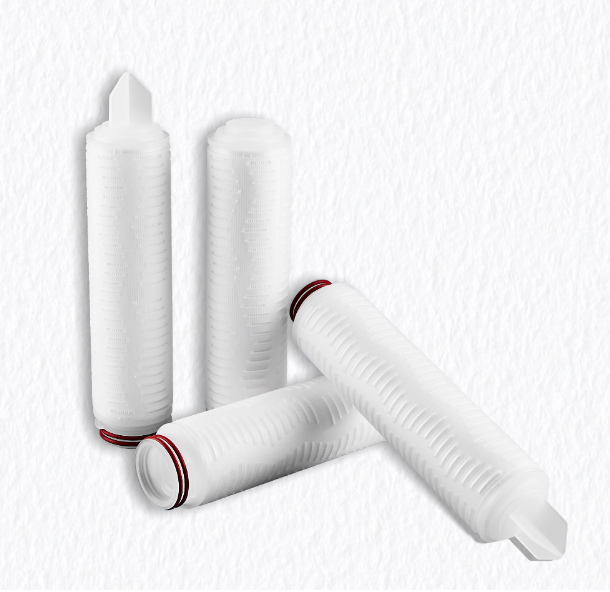
Pleated cartridges work primarily by surface filtration: fluid passes through a fixed pore structure while particles are retained at/near the media surface. The pleats increase total area, so the same flow is spread across more media—reducing localized loading and helping stabilize ΔP.
Consistent pore performance: fixed pore membranes can deliver repeatable retention behavior.
Lower clogging rate: more surface area delays blinding for many particle types.
Process protection: helps protect downstream membranes, pumps, valves, and critical product streams.
Many pleated membrane materials (commonly PES, Nylon, PTFE) are used when processes require stable filtration performance—especially important in sensitive industries like pharma, microelectronics, and specialty chemicals.
Because the pleated area is larger, pleated cartridges can often retain more contaminant mass before ΔP rises to your changeout limit—supporting longer runs and fewer replacements.
With correct sizing, pleated cartridges can reduce:
energy consumption (less pumping effort),
unplanned downtime from rapid ΔP rise,
maintenance labor.
Pleated filter cartridges improve filtration efficiency by combining high surface area with controlled pore structures (especially in membrane-based media). The pleats create a larger “active” filtration zone that can capture more particulate while maintaining stable throughput.
Why this matters in real systems
Better particle control supports consistent product quality.
Reduced particulate carryover can protect sensitive downstream steps (e.g., final polishing, membrane protection, filling lines).
Compared with melt-blown, string wound, and depth filters
While depth filters are useful for heavy solids, pleated membrane-style filtration is often preferred when you need:
tighter retention,
more consistent results,
better performance predictability.
For high-purity processes, consider browsing PES capsule filters and Nylon capsule filters on the Loong Filtration products page: https://www.loongfiltration.com/products.html
A major advantage of pleated cartridge filtration is the ability to match media to chemistry:
PP (Polypropylene): widely used for many aqueous applications and general industrial filtration.
PTFE: chosen for aggressive chemicals/solvents where chemical resistance is critical.
PES / Nylon: often used in high-purity and process filtration where wettability and performance consistency are important (final selection depends on the exact chemical exposure).
From your product list, Loong Filtration offers:
Multi-layer PP Capsule Filter (Filter media: PP)
Hydrophilic PTFE Capsule Filter and Hydrophobic PTFE Capsule Filter (Filter media: PTFE)
PES Capsule Filter and High Capacity PES Capsule Filter (Filter media: PES)
Nylon Capsule Filter and High Capacity Nylon Capsule Filter (Filter media: Nylon)
Ink Specific Capsule Filter (Filter media: PES, Nylon, PTFE, PP)
Why compatibility reduces cost and risk
fewer media failures and fewer unexpected replacements,
lower risk of extractables/contamination from incompatible materials,
safer, more reliable operation across changing process fluids.
Pleated media is designed to run longer—especially when the system is properly sized and the media matches the contaminant type.
How pleats extend service life
more filtration area delays surface blinding,
better distribution of particulate loading reduces “early clogging hotspots,”
high capacity variants (like your High Capacity PES Capsule Filter and High Capacity Nylon Capsule Filter) are built specifically to extend runtime in demanding processes.
Business impact
fewer production interruptions,
reduced maintenance hours,
lower cartridge consumption over a year.
Pleated cartridge and capsule formats are popular because they simplify maintenance:
Cartridges fit common housings (depending on end-cap style).
Capsule filters are compact, enclosed, and often easy to integrate into point-of-use lines and pilot-scale systems.
General installation steps (best practice)
Isolate and depressurize the filtration line.
Remove the used cartridge/capsule and dispose of it per SOP.
Inspect seals and seating surfaces.
Install the new element, verify correct orientation/fit.
Repressurize slowly and check for leaks.
Record initial ΔP for performance tracking.
Why this saves money
Time spent changing filters is real operating cost. Pleated filters’ longer service life + simpler swap procedures = lower labor cost and less downtime.
Pleated cartridges often win on total cost of ownership, even if a basic depth cartridge looks cheaper upfront.
Cost drivers pleated cartridges improve
fewer changeouts (labor + downtime),
lower disposal volume over time,
less process disruption from ΔP spikes,
better product protection (fewer quality deviations).
A practical buying approach is to evaluate:
cost per month of operation (not cost per piece),
filtered volume before changeout,
stability of flow and ΔP.
Pleated filtration also offers:
Multiple media options (PES, Nylon, PTFE, PP) to match chemical and cleanliness needs.
Hydrophilic vs hydrophobic choices (e.g., Hydrophilic PTFE vs Hydrophobic PTFE) for different wetting and venting behaviors.
High capacity variants to extend runtime in higher particulate loads.
Cross-industry adaptability (from laboratory to full industrial production).
Use this selection checklist to buy confidently.
PP pleated: general aqueous filtration, cost-effective, widely applicable.
PES pleated: commonly used for high-purity applications where consistent performance matters.
Nylon pleated: selected for certain aqueous/solvent processes depending on compatibility needs.
PTFE pleated: best when chemical resistance is the top priority; choose hydrophilic vs hydrophobic based on whether you need easy wetting or gas/vent applications.
Tip: If you’re filtering inks or complex fluids, consider purpose-built options like Ink Specific Capsule Filter (media: PES/Nylon/PTFE/PP) to simplify selection.
Upstream prefiltration: to protect final filters and extend life
Final filtration: for product quality, critical equipment, or high-purity requirements
Nominal ratings can vary by manufacturer and test method.
Absolute ratings are tied to defined retention targets and are preferred for critical applications.
Cartridge length/diameter and end caps (for standard housings)
Capsule connection type and integration requirements (for point-of-use/pilot)
Track ΔP over time; replace at a defined limit.
Avoid sudden flow ramp-up (helps reduce shock loading).
Use upstream prefiltration if solids are high.
For Pharma & Biotech applications, confirm whether your filter media and capsule/cartridge construction supports your sterilization method (e.g., steam/hot water/chemical sanitization) and validate per SOP.
Keep filters sealed until use.
Prevent pleat damage during handling.
Store clean and dry away from direct sunlight and contamination.
They’re widely used in Pharma & Biotech, Microelectronics, Food & Beverage, Fine Chemical, Laboratory, and Water Treatment, especially where stable filtration and consistent particle removal are required.
It depends on contaminant load, flow rate, and allowable ΔP. Many facilities replace when ΔP reaches a set threshold or when flow no longer meets process demand.
Sometimes, but it depends on the media and contaminant. In high-purity or regulated processes, filters are frequently treated as single-use to minimize contamination risk.
Pleated cartridges primarily use surface filtration with higher surface area and often more controlled pores. Depth cartridges capture particles throughout the media thickness and can be better for very heavy solids, but may be less consistent at fine filtration.
They provide more filtration area, lowering face velocity and distributing flow more evenly—often resulting in lower ΔP at a given flow rate.
Pleated filter cartridges deliver measurable operational advantages: superior filtration efficiency, wide chemical compatibility, prolonged service life, easy installation, and cost-effectiveness. With media options like PES, Nylon, PTFE, and PP—plus specialized capsule filters such as Hydrophilic/Hydrophobic PTFE Capsule Filters, High Capacity PES/Nylon Capsule Filters, Multi-layer PP Capsule Filters, and Ink Specific Capsule Filters—you can match filtration performance to your exact process needs.
To explore media options by application (Pharma, Microelectronics, Food & Beverage, Fine Chemical, Lab, Water Treatment) and request pricing or recommendations, visit: https://www.loongfiltration.com/products.html


