
- Products
- Applications
- Services
- About Us
- Success Stories
- Contact Us
Views: 213 Author: Site Editor Publish Time: 2026-04-17 Origin: Site
Traditional filtration methods often force a difficult operational compromise. You typically sacrifice facility floor space, suffer ongoing product loss, and face massive initial capital expenditure. Plate and frame presses epitomize these old-school frustrations. Modern process engineers need a distinctly agile solution. Lenticular Filters offer a completely closed-system alternative. They successfully bridge the critical gap between high-capacity depth filtration and essential production agility. This article serves as your technical and commercial evaluation roadmap. We will help you understand, select, and implement a depth stack filter system effectively. You will learn how to bypass generalized marketing claims and evaluate hard engineering metrics instead. Whether you manage volatile fluid processing in food and beverage, biopharma, or chemical manufacturing, you need reliable data. We will cover structural mechanics, specific module materials, and precise scalability thresholds. By the end, you will know exactly how to integrate these high-yield units.
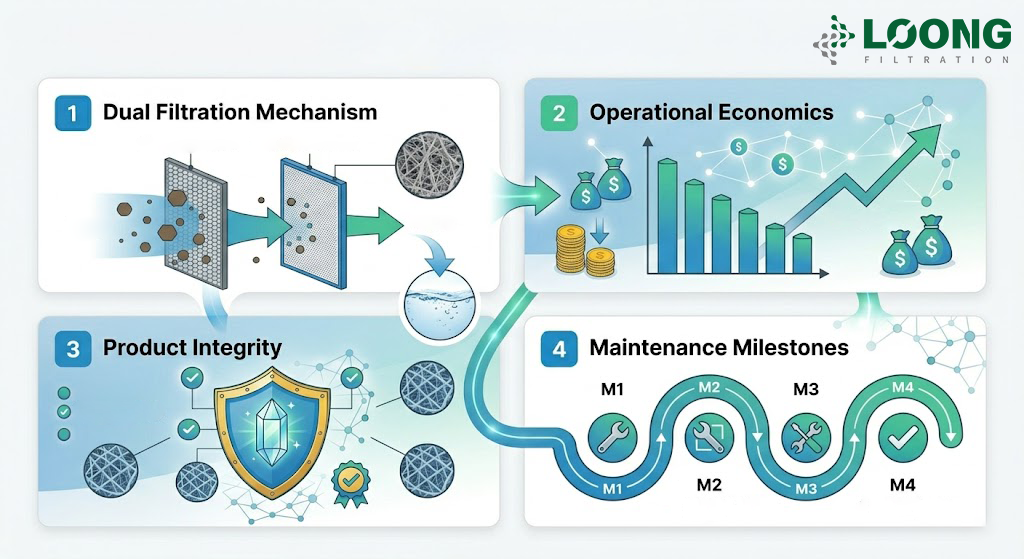
Dual Filtration Mechanism: Lenticular filters combine a mechanical "tortuous path" with electrokinetic adsorption (Zeta potential) to capture sub-micron particles.
Operational Economics: Upgrading to a lenticular housing system requires significantly lower initial capital ($1k–$3k range) compared to traditional plate and frame setups (~$100k).
Product Integrity: The completely enclosed design allows for nitrogen purging, practically eliminating Dissolved Oxygen (DO) pickup and drip loss.
Maintenance Milestones: Standard replacement is dictated by a hard metric—typically a 25 psi differential pressure—rather than visual guesswork.
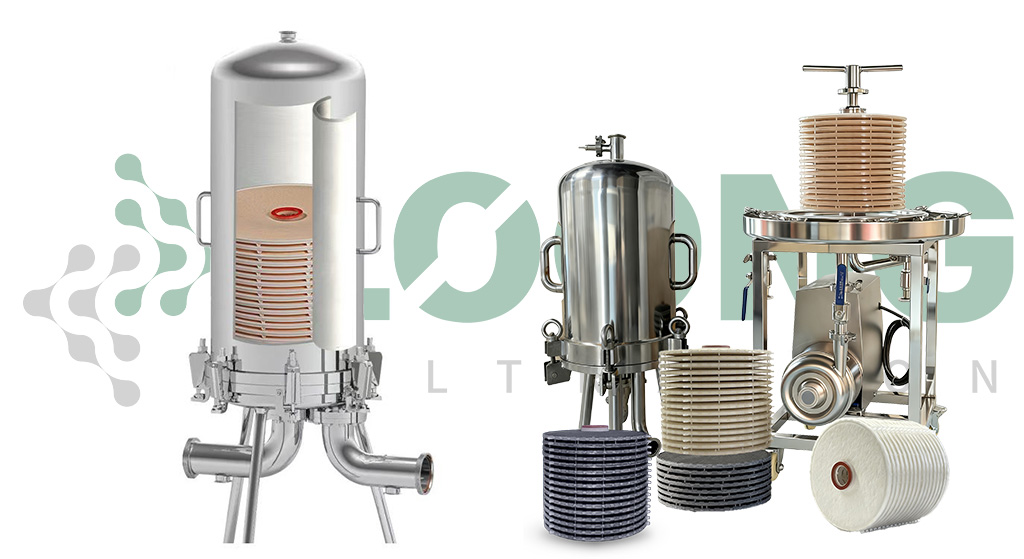
To evaluate these systems correctly, you must first understand their internal architecture. A modern Lenticular Filters system relies on a highly efficient modular design. Each unit consists of multiple dual-media discs. A strong polypropylene matrix safely separates these active discs. Manufacturers stack these sub-assemblies vertically inside a watertight, pressure-resistant housing. This creates a compact but massive total surface area.
Let us break down the internal fluid movement. The operation relies on a very specific outside-in flow path:
Unfiltered fluid enters the pressure vessel via an external pump.
The liquid rapidly entirely surrounds the stacked internal modules.
Positive pressure forces the liquid outside-in through the thick media matrix.
The newly cleaned fluid gathers in the central core and exits the housing.
Deep filtration does not just block particles at the surface layer. Instead, it relies heavily on the "tortuous path" principle. The fluid navigates a complex, twisting maze inside the thick filter matrix. This journey actively exhausts the kinetic energy of suspended microscopic particles. They become physically trapped throughout the entire volume of the media bed. Surface filters clog quickly. Depth filters hold immense amounts of solid debris before failing.
Mechanical capture represents only half the story. High-performance modules also utilize a secondary electrokinetic capture mechanism. Industry professionals call this the Zeta potential. Filter manufacturers blend specialized wet-strength resins into the cellulose base. These specific resins generate a strong positive charge across the filter matrix. This charge actively adsorbs negatively charged contaminants from the liquid stream. It effectively catches tiny impurities much smaller than the filter's nominal micron rating. This dual-action approach guarantees unparalleled fluid clarity.
Traditional sheet filters operate as notoriously open-air systems. They rely heavily on external drip pans to catch inevitable liquid leaks. This messy setup causes constant, measurable product loss every single shift. Enclosed housings eliminate this leakage entirely. You keep every drop of your valuable product securely inside the pressurized system. The floor stays dry, and your yield increases immediately.
Breweries and beverage makers face extremely strict quality constraints. Dissolved Oxygen (DO) severely degrades product flavor and destroys shelf life. Enclosed housings solve this persistent oxidation problem. They allow operators to perform both forward and reverse nitrogen purging. You purge the housing before introducing the beverage. This aggressive gas management practically eliminates DO ingress. Your beer or wine retains its intended flavor profile.
Plate and frame presses demand massive horizontal floor space. They dominate production rooms. They also require heavy initial investments, often approaching the $100,000 mark. In stark contrast, modular housings utilize a smart vertical design. They require minimal floor space. The initial hardware investment for a standard sanitary housing typically ranges between $1,000 and $3,000. You achieve equal or better throughput capacity without the crippling upfront CapEx expense.
Volatile, high-value, or hazardous fluids require strict containment protocols. Think of explosive cannabis extracts or potent active pharmaceutical ingredients. An open-air drip system presents a massive regulatory liability. An enclosed, sanitary system ensures absolute safety compliance. It protects operators from dangerous chemical exposure. It also prevents any accidental environmental contamination during processing.
System Feature | Traditional Plate & Frame Press | Lenticular Housing System |
|---|---|---|
Footprint | Large, horizontal layout | Compact, vertical stack |
System Design | Open-air, prone to contamination | Fully enclosed, sanitary |
Drip Loss | High (requires drip pans) | Virtually eliminated |
DO Management | Poor, high oxidation risk | Excellent (Nitrogen purgeable) |
Initial CapEx | Extremely High (~$100,000) | Low ($1,000 - $3,000 range) |
The connection point completely defines your bypass risk. You must choose your hardware interface carefully to prevent catastrophic batch failures.
Flat Gasket (DOE) modules are incredibly common and cost slightly less. However, they require a rigid center post and strict spring tension for sealing. Operators must tighten them manually. Improper torque can increase the risk of fluid bypass, allowing unfiltered liquid to slip past the gasket into the clean channel. To minimize this risk, ensure that the center post is correctly positioned and that the gasket is evenly compressed according to the manufacturer’s torque specifications. Regular inspection and maintenance of the gasket and post assembly are essential for consistent performance.
Beyond the interface, you must match the internal media formulation to your desired production outcome. The wrong media choice guarantees a processing bottleneck.
Cellulose & Diatomaceous Earth (DE): This blend remains the undisputed standard for high-solids fluid clarification. You see it heavily used for finishing wines, hard seltzers, and thick glucose syrups. DE provides a highly porous, honeycomb-like internal structure. It effectively traps heavy solids without restricting your overall flow rate.
Activated Carbon Impregnation: Botanical extractors use this specific media to strip unwanted chlorophyll. It works perfectly for aggressive decolorization and odor removal. Best of all, you avoid the dirty, messy handling of loose carbon powder. The carbon stays locked inside the matrix. Always ensure your selected modules meet FDA 21CFR 176.170 compliance for safe food contact.
You must understand the primary physical limitation of classic module designs. They are extremely sensitive to backpressure. Even a minor reverse pressure event can spell absolute disaster. A backpressure as low as 0.05 bar easily deforms unprotected filter media. It can rupture the internal discs, sending solid debris downstream into your clean product tank.
Modern engineering fixes this critical vulnerability. Newer generation modules feature advanced dual-separator reinforcement. Manufacturers secure these rigid separators via snap-fit connectors or ultrasonic welding. These robust upgrades resist heavy mechanical stress during operation. They also prevent severe thermal deformation during harsh steam-in-place (SIP) sterilization procedures. You gain massive operational peace of mind.
Do not blindly trust generalized marketing claims about backwashing capabilities. You can only regenerate a module safely if it includes a protective external netting or scrim. Without this tough outer support, reverse fluid flow will immediately destroy the internal media. Furthermore, you must remember a hard chemical rule. Carbon-impregnated filters cannot undergo backwash regeneration under any circumstances. Once the carbon exhausts its physical adsorption capacity, you must discard the module entirely.
You must establish realistic baseline expectations before purchasing any equipment. System sizing directly dictates your production bottleneck. For instance, a mid-sized operation might specify a 16-inch, 4-module stack. This specific configuration typically processes around 45 gallons per minute (gpm). Enterprise-level facilities scale up dramatically to meet consumer demand. They often run massive 6-module configurations capable of handling 110+ gpm easily.
Challenging, viscous fluids break traditional equipment. Thick syrups quickly clog standard sheet filters. They also cause expensive centrifuges to fail or underperform. Lenticular designs handle these dense, sticky liquids effortlessly. They offer massive depth and incredibly large surface areas. This architecture allows thick liquids to pass through without generating immediate, crippling pressure spikes.
Buyers should take immediate, specific steps to ensure a successful integration. Do not guess on critical specifications. We recommend following these procurement action items:
Audit your current differential pressure metrics on existing equipment to establish a baseline.
Measure your available vertical clearance on the production floor to accommodate the housing dome safely.
Consult an applications engineer to perfectly match the exact micron rating to your specific fluid viscosity.
Shifting to a depth stack filter system goes far beyond a simple fluid clarification upgrade. It represents a facility-wide improvement in overall product yield, daily sanitation, and overhead reduction. You move from a messy, open-air process to a highly controlled, sanitary environment. Your operators spend less time cleaning floors and more time managing actual production.
To capitalize on these operational advantages, take proactive steps today. First, evaluate your current liquid loss from open-air drip pans to calculate immediate recovery savings. Next, request a thorough fluid analysis from your filtration supplier to validate actual flow rates. Always ask for a pilot housing unit to test media compatibility before committing to a full-scale facility rollout. Finally, transition your team away from subjective visual filter checks by implementing rigid, data-driven differential pressure protocols.
A: Base it on data, not time. Replace when the differential pressure reaches 25 psi, or, for carbon filters, when the sight glass shows color breakthrough.
A: Yes, conditionally. Modules can be flushed with warm water or chemically regenerated, increasing throughput by up to 50%, provided they are structurally rated for it.
A: Lenticular filters utilize thick, stacked discs designed for massive depth filtration and high-solids holding capacity, whereas standard pleated cartridges are typically surface filters for final polishing.


