
- Products
- Applications
- Services
- About Us
- Success Stories
- Contact Us
Views: 132 Author: Site Editor Publish Time: 2026-01-07 Origin: Site
A filter bag is a tool that helps take out unwanted bits from liquids or air. It is used in factories and other places. You can find filter bags in food, medicine, and chemical industries. Look at the table below for some examples:
Application Area | Type of Filter Bag |
|---|---|
Water Treatment | Liquid Filter Bags |
Dust Collection | Dry Filter Bags |
Paint & Coatings | Liquid Filter Bags |
You need strong filtration to keep machines safe. It also helps you follow safety rules. Filtration keeps products clean and pure. A filter bag works well and helps you save time and money.
Reasons to use filtration systems:
You want good results.
You need to keep machines safe.
You must follow safety and environment rules.
Filter bags help take out unwanted particles from liquids and air. This keeps products clean and machines safe. Picking the right filter bag material is important. You might use polypropylene or polyester. The material should fit your industrial needs. You need to check and change filter bags often. This helps the system work better and saves money. Filter bags also help you follow safety rules. They protect products and workers in many industries. Good filter bags cost more at first but save money later. You will not need to replace or fix them as much.

A filter bag is a tool that helps take out unwanted stuff from liquids or air. People use it in many places to keep things clean and machines working right. The filter bag lets liquid or air go through its walls but catches dirt, dust, or other bad things inside. Most filter bags look like a tube or a pocket and fit inside a filter holder. You can find them in water plants, food factories, and chemical plants.
A filter bag is built to be strong. Sometimes it has a mesh basket inside to help, especially when there is a lot of pressure. The liquid or air usually moves from the outside of the bag to the inside. This way, the bag catches the bad stuff and keeps it from getting out. The table below shows what makes a filter bag special:
Feature | Description |
|---|---|
Definition | A device for filtration, made of a bag-shaped filter medium. |
Construction | Made from woven or nonwoven materials, sometimes with a support basket. |
Operation | Fluid flows from outside to inside, trapping contaminants inside the bag. |
Applications | Used in chemicals, food, coolants, cleaning fluids, paints, and varnishes. |
Materials | Polypropylene, polyester, nylon, and other advanced fibers. |
Formats | Mesh, single layer, multilayer, pleated, and graded pore types. |
LOONG FILTRATION makes filter bags that are strong and last a long time. You can pick from different ways the bag is put together, like ultrasonic welding, sewing, or full welding. Ultrasonic welding and full welding make the bag hold together without any seams. This means the bag will not leak or break easily. These ways also mean you do not need thread or glue, so nothing extra gets into your product.
You can choose different kinds of filter bags for what you need. There are two main kinds: depth filtration and surface filtration. Depth filtration uses thick stuff, like needle felt, to catch dirt all through the bag. Surface filtration uses a mesh, like monofilament, to catch dirt on the outside.
The material you pick for your filter bag is important. Each one is good for different things. Here is a table to show you the most common materials and what they are used for:
Material | Advantages | Applications |
|---|---|---|
Polypropylene | Chemical resistance, lightweight, cost-effective | Chemical processing, food & beverage, cleanup |
Polyester | Strong, UV resistant, durable | Automotive, aerospace, wastewater |
Nylon | High strength, abrasion resistance | Water treatment, chemical processing |
Nomex | Heat stable, chemical resistant | Food, beverage, pharmaceuticals |
PTFE & PVDF | Top chemical resistance, non-stick | Semiconductors, high temperature |
When you use a LOONG FILTRATION filter bag, you can pick needle felt for depth filtration or monofilament mesh for surface filtration. Polypropylene is good for chemicals, and polyester works well with heat and tough jobs. You can match the filter bag to your job, whether you need to filter hot liquids, strong chemicals, or tiny bits.
Tip: Always check if your filter bag materials are certified. LOONG FILTRATION uses SGS and FDA certified materials. This means the filter bag is safe for food, medicine, and other important products.
You also want to keep your process clean. LOONG FILTRATION puts each filter bag in a cleanroom. This keeps out dust and dirt, so only the filter bag touches your product. You can trust your filter system to work well and keep your products safe.
A filter bag helps take out unwanted bits from liquids or gases in factories. First, the fluid goes into the filter housing. Then, it moves through the filter bag. The bag acts like a wall with tiny holes. These holes let clean fluid go through but catch dirt, dust, sand, and rust. This keeps machines safe and products clean.
There are two main ways a filter bag works:
Depth filtration: The bag has thick layers. Big particles get stuck near the top. Smaller ones go deeper and get trapped inside. This type holds more dirt and is good for dirty fluids.
Surface filtration: The bag uses a thin mesh. Dirt stays on the outside and forms a layer called a "filter cake." This layer can help catch even smaller bits as it grows.
A filter bag can catch very tiny or bigger particles. You can use it for fast-moving fluids and large amounts. This makes it great for many factory jobs.
Tip: Always pick a filter bag with the right micron rating. This helps you remove the right size particles and get the best results.
You want your filter bag to catch every bit of dirt. It should not let any fluid leak around the edges. LOONG FILTRATION uses a special zero-bypass sealing system to stop leaks.
Here is how the zero-bypass sealing system works:
Feature | Description |
|---|---|
Reliable Seal | A strong flange makes sure all fluid goes through the filter bag. No fluid can slip past the sides. |
Zero Bypass | Ultrasonic or heat seals join the bag’s layers without holes or gaps. This stops leaks and keeps fibers from getting into your product. |
This design keeps your filter system safe and working well. The filter bag catches all the dirt, so nothing bad gets into your final product. This is very important for food, chemicals, and car paint, where even a small leak can cause big problems.
Note: LOONG FILTRATION uses special welding and certified materials. This means your filter bag will not leak and will always keep your products safe and pure.
A filter bag with zero-bypass sealing helps you feel sure. You know your filter system is working right and keeping your machines and products safe every time.
You want your filtration system to work well every time. Bag filters catch almost all unwanted particles, so they are very efficient. Most bag filters in factories can remove about 94% to 98% of contaminants. Some special bag filters can even remove up to 99.9%. This means your liquids are cleaner and your products are safer.
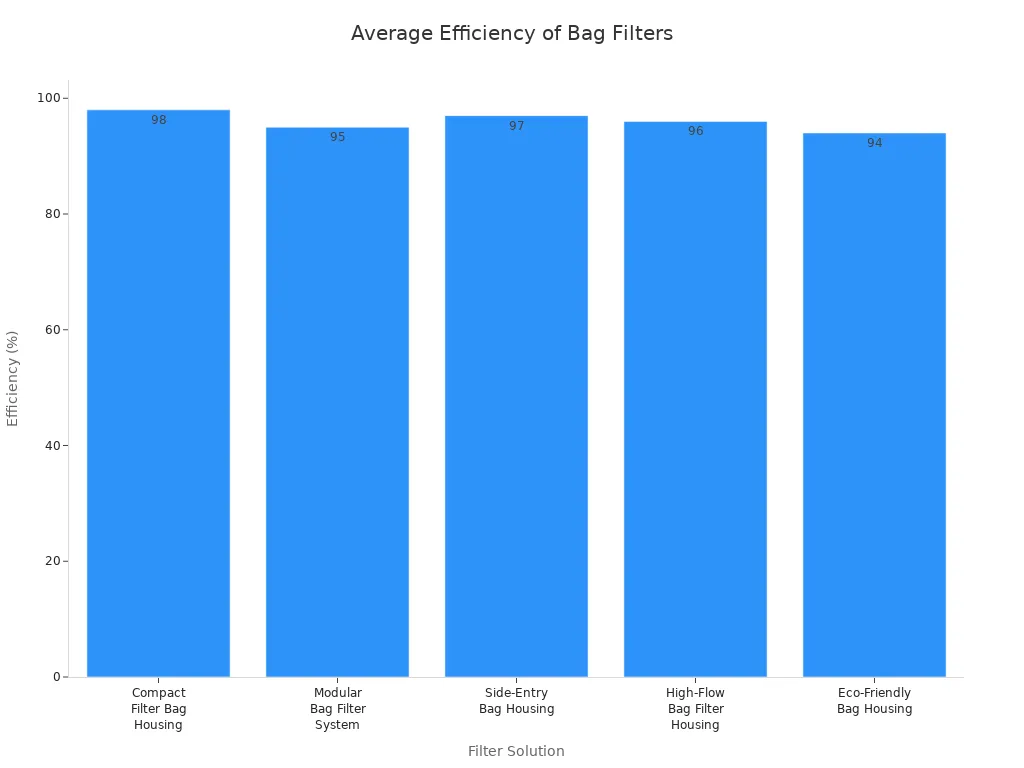
The chart shows that bag filters work better than many other filters. Using a filter bag helps protect machines and keeps everything running smoothly. It also lowers the chance of machines breaking down.
Bag filters are reliable and work in many places, like food, chemical, and car factories. They remove dirt, sand, and other bad things. If you pick the right filter bag, your system will last longer and work better. Changing the filter bag on time and checking it often keeps your system safe and strong.
Bag filters help you save money in different ways. They can clean a lot of liquid, from 90 to 2,400 gallons each minute. This makes them good for big jobs. You do not need to buy or change bag filters as often as other filters. Bag filters usually last longer, so you save money.
Here are some reasons why bag filters are a smart choice:
They cost less at first than cartridge filters.
They last longer if you use them right.
You spend less money on fixing and changing them.
Bag filters also help keep your workplace safe. They take out harmful stuff and help you follow safety rules. This is very important in food, drink, and medicine factories. The table below shows how bag filters help with safety:
Benefit | Description |
|---|---|
Safety Standards Compliance | Goes beyond safety rules, keeping people and products safe. |
Effective Contaminant Removal | Takes out harmful stuff, so products last longer and people stay healthy. |
Safety | Pressure vessels that meet ASME rules are safer and less likely to break. |
When you use a LOONG FILTRATION filter bag, you get products with SGS, FDA, and ISO certifications. These show your bag filter is high quality and safe. You can trust your filter system to protect your products and your workers.
Filter bags are used in many industries. Each place uses them for different reasons. The table below shows where filter bags are used and what they remove:
Industry | Primary Contaminants Targeted |
|---|---|
Food & Beverage | Juice particles, dairy solids, oil haze |
Electronics Manufacturing | Ultra-clean rinse water, micro-particles |
Chemical Processing | Catalyst dust, fine solids |
Paint & Coatings | Lumps, pigment clumps |
Water Treatment | Sand, rust, debris |
Metalworking Fluids | Metal fines, coolant sludge |
Industrial Wastewater | Large solids, organic matter |
Construction & Mining | Slurry, large particulates |
Filter bags help keep products clean and machines safe. In food factories, they remove small bits from juice or cheese brine. Electronics makers use them to keep rinse water clean for chips. Chemical plants use filter bags to catch powder and keep reactions pure. Paint factories use filter bags to stop lumps from ruining paint. Water plants use them to protect filters and give clear water. Filter bags are also used in dust systems to trap dust and keep air clean.
Here are some examples:
Cheese plants use filter bags to keep salt water clean without heating it up.
Drink factories use special filter bags to meet strict rules.
Chemical makers use pure filter bags to take out tiny bits from products.
You need to choose the right filter bag for your job. Think about what you want to remove, how hot or strong your fluid is, and what chemicals you use. The table below can help you pick:
Factor | Description |
|---|---|
Process Conditions | Make sure your filter bag can handle heat and pressure. |
Filter Media Types | Pick needle felt for depth or mesh for surface filtration. |
Housing Choices | Choose top or side inlet designs for easy use and good results. |
Also look at these things:
Filtration efficiency: Make sure your filter bag catches the right size bits.
Chemical compatibility: Use a filter bag that does not get damaged by your chemicals. This helps your filter bag last longer.
Temperature tolerance: Some filter bags work better in hot or cold fluids.
Mechanical strength: Pick a filter bag that will not break under pressure.
Tip: Always match your filter bag material to your chemicals. This helps your filter bag last longer and keeps your process safe.
If you pick the right filter bag, your products stay clean, your machines stay safe, and your work goes smoothly.
You need to keep your industrial air filtration system working well. Regular care helps your filter bag last longer and keeps your process safe. You should check your filter bags often for signs of wear or damage. In many industrial air filtration systems, you should replace filter bags every six months to a year. Some places with heavy use may need more frequent changes. Baghouse filters can last from one to three years, but this depends on how hard your system works.
Here are some best practices for caring for your industrial air filtration system:
Inspect filter bags and housings for leaks or damage.
Clean the housing to stop dirt from building up.
Check seals and gaskets to make sure no air or fluid escapes.
Install filter bags correctly to prevent leaks.
Keep a schedule for replacing filter bags, even if they look fine.
Record all maintenance to track performance.
Tip: A regular cleaning and inspection plan helps you spot problems early and avoid costly breakdowns.
You want to manage costs in your industrial air filtration system. The quality of your filter bag affects how often you need to replace it. Higher quality media lasts longer and saves money over time. Durable filter bags also lower labor and disposal costs.
Cost Factor | Description |
|---|---|
Filter Media Quality | High-quality media lasts longer and reduces how often you need to change bags. |
Replacement Costs | Durable bags mean less time and money spent on changing and throwing away old bags. |
Lifecycle Costs | Good filter bags may cost more at first but save money in the long run. |
You also need to think about delivery and supply. LOONG FILTRATION offers rapid global delivery. You can order 50 pieces for a trial or 5,000 pieces for a full year’s supply. This support helps you keep your industrial air filtration system running without delays.
Note: Always choose the right filter bag for your industrial air filtration needs. This keeps your system efficient and your costs low.
You use filter bags to keep your factory clean and safe. They help your machines work better and last longer. New technology lets you catch even smaller bits of dirt. This means your machines do not break as often. You also follow important rules for safety and the environment. Good filter bags make the air cleaner and help you spend less money. Look at the table to see how filter bags help your work:
Impact Area | Description |
|---|---|
Compliance | Helps you meet environmental rules |
Energy Savings | Reduces operating costs by up to 30% |
Process Optimization | Improves waste and emissions management |
Pick LOONG FILTRATION if you want your machines to work well and your process to be better.
You use a filter bag to trap dirt, dust, or unwanted particles from liquids or air. This keeps your machines safe and your products clean.
You should check for pressure changes or slower flow. If you see dirt building up or notice leaks, it is time to replace the filter bag.
Most filter bags are for single use. You should replace them to keep your system safe and your products pure. Reusing can lower performance.
You can choose polypropylene for chemicals, polyester for heat, or nylon for strength. Always match the material to your process needs for the best results.


