
- Products
- Applications
- Services
- About Us
- Success Stories
- Contact Us
Views: 210 Author: LOONG FILTRATION Publish Time: 2025-12-04 Origin: Site
High Impurity Loading: After 12 months of aging in oak barrels, residual lees, dead yeast, and tartaric acid crystals in the stainless steel fermentation tanks can easily clog the filter media.
Stringent Clarity Requirements: As a premium red wine, the client requires the removal of all visible colloids and turbidity to ensure the wine appears crystal clear under light.
Extremely Low Pressure Environment: The on-site feed pressure is only 0.3 - 0.0 bar, and the bottling machine's feed pressure needs to be maintained at 0.1 bar. Maintaining a stable flow rate of 2,000 L/H under low-pressure conditions is a core design challenge.
Biological Stability Risk: Failure to thoroughly remove residual microorganisms before bottling can easily lead to secondary fermentation, seriously threatening the brand's reputation.
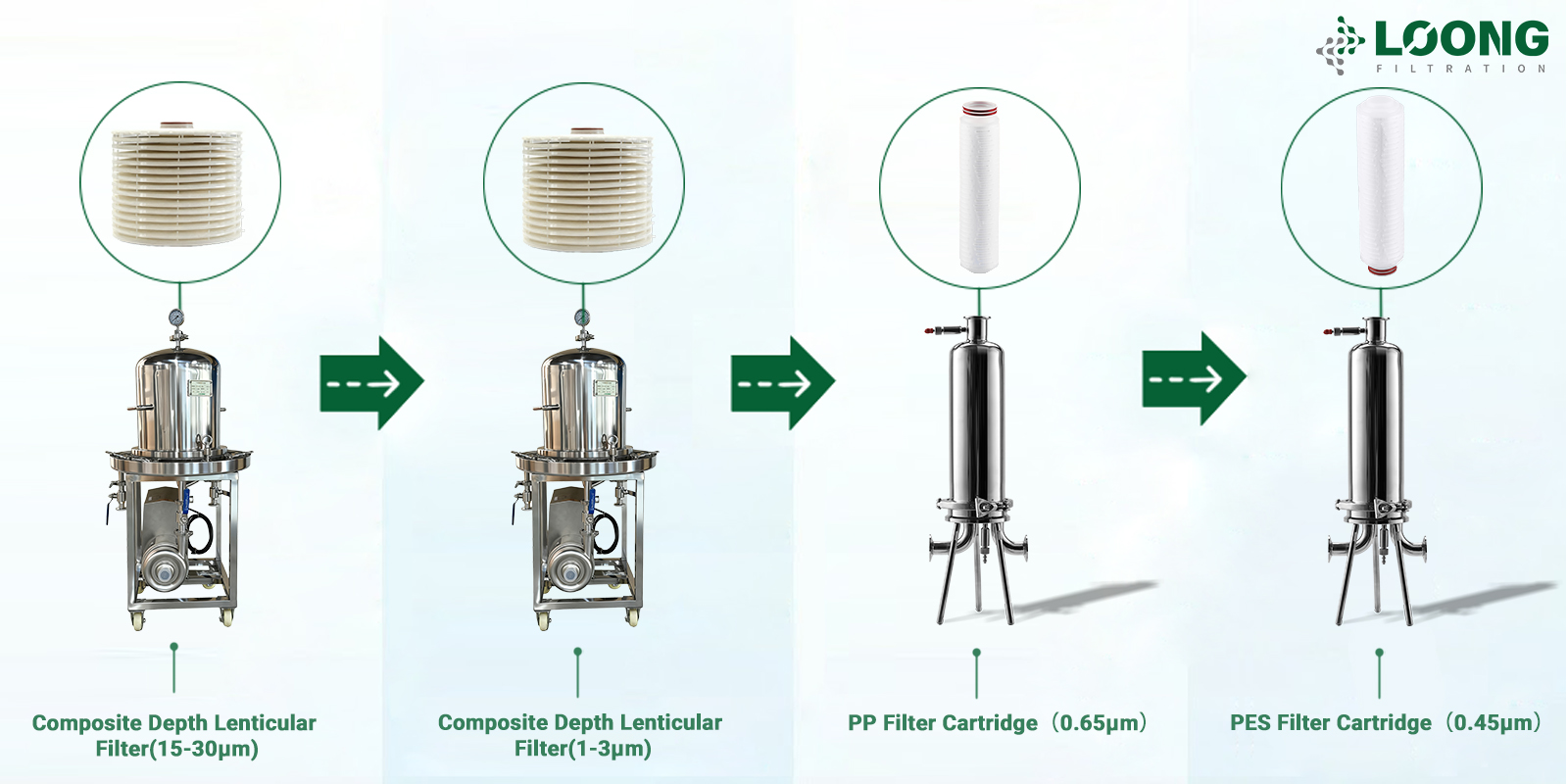
Coarse Filtration: Diatomaceous earth filtration removes yeast residue, tartaric acid crystals, and other large particles.
Pre-filtration: Membrane stack filtration removes colloids, turbidity, and residual lees in the stainless steel fermentation tank, ensuring a clear wine.
Pre-filtration 1: 16-inch, 16-layer, 2-core, 15-30 micron Lenticular Filter Housing + Lenticular Filter
Pre-filtration 2: 16-inch, 16-layer, 2-core, 1-3 micron Lenticular Filter Housing + Lenticular Filter
| Component Name | Function | Benefit |
| Primary Membrane Stack Filtration (15-30μm) | Intercepts tartaric acid crystals and coarse lees. | Greatly relieves system pressure and prevents premature clogging of downstream filter media. |
| Secondary Membrane Stack Filtration (1-3μm) | Deeply removes tiny colloids and suspended solids. | Achieves physical "sand removal" and clarification, resulting in a clear wine. |
Composite Depth Lenticular
Filter(15-30μm)
Composite Depth Lenticular
Filter(1-3μm)
Composite Depth Lenticular Filter—M
| Pure lignocellulose membrane stack | With no blind spots in its water-friendliness, its flow rate surges by 40%. |
| Natural antibacterial black technology | Microbial contamination reduced by 70% |
| Super acid and alkali resistant | Cleaning recovery rate ≥95%, lifespan extended by 30%. |
| Completely biodegradable | Green and environmentally friendly, reducing solid waste costs by 60%. |
Fine Filtration: PP pleated filter cartridge removes residual yeast.
Sterilization Filtration: PES pleated filter cartridge removes microorganisms, achieving sterilization requirements.
Fine Filtration: 3-cartridge, 30-inch liquid filter + 0.65μm PP pleated filter cartridge
Sterilization Filtration: 3-cartridge, 30-inch liquid filter + 0.45μm PES pleated filter cartridge
| Component Name | Function | Benefit |
| PP Filter Cartridge(0.65μm) | Targets and removes residual yeast cells. | Reduces the workload on sterilization filters, significantly extending the lifespan of high-value PES filters. |
| PES Filter Cartridge(0.45μm) | Absolutely retains bacteria and microorganisms, achieving physical sterilization. | Ensures long-term biological stability after bottling, preventing spoilage. |
Advantages of PP Filter Cartridge
| Ultra-high filtration accuracy | Impurity rejection rate ≥99.9% |
| Resistant to acid and alkali corrosion | Wide applicable pH range |
| Low pressure drop and high dirt holding capacity | 50% extended service life |
| Compliant with safety certifications | Suitable for direct contact with food and pharmaceuticals |
| Supports high-temperature sterilization | Stable performance after repeated use |
Advantages of PES Filter Cartridge
| Ultra-low adsorption rate | Active ingredient recovery rate ≥99.5% |
| Broad-spectrum sterilization performance | Microbial retention rate up to 100% |
| Excellent temperature and pressure resistance | Can withstand 121℃ saturated steam sterilization for 30 minutes, and its filtration performance remains unchanged after 100 repeated sterilizations |
| High pleat density design | 50% increase in dirt holding capacity |
| Meets stringent industry certifications | Passed FDA food contact certification and USP Class VI biocompatibility test |
Superior Visual Appeal: Through a two-stage lenticular filtration system, the wine achieves a perfect balance between color richness and clarity.
Capacity Expansion Compatibility: The system is designed with a flow rate of 2,000 L/H, perfectly covering current production levels and providing ample margin for future 2-3 times capacity expansion.
Optimized Low-Pressure Operation: For customers' specific low-pressure operating conditions, we have optimized the internal flow channel structure of the filter to ensure stable output in environments ranging from 0.1 to 0.3 bar.
Significantly Reduced Costs: The staged filtration mechanism reduces the frequency of expensive final filter cartridge replacements by more than 40%, significantly optimizing the filtration cost per bottle of wine.
Hygiene Standards: All filter housings are made of SS316L grade stainless steel, meeting the highest food contact safety standards.
True "Absolute Precision": Our PES sterilization filter cartridges undergo rigorous 100% integrity testing (bubble point and diffusion flow testing) to ensure effective microbial interception.
Customized Integration Capabilities: We not only manufacture filtration products but also excel at providing personalized customization services based on client requirements.
A1: The solution optimizes the internal flow channel structure of the filter to minimize internal pressure drop. Simultaneously, the system is equipped with a VFD frequency converter to precisely adjust the flow rate, ensuring a stable output of 2,000 L/H even under low pressure.
A2: Absolutely. This design not only perfectly covers the customer's existing production capacity needs but also provides ample room for the customer's strategic transformation, accommodating future expansion needs of 2-3 times.
A3: This is to achieve "stepped interception." The primary membrane stack intercepts tartaric acid crystals and coarse lees to relieve pressure; the secondary membrane stack deeply removes tiny colloids. This staged filtration effectively protects the expensive precision filter cartridges downstream, preventing premature clogging.
A4: This membrane stack has hydrophilic properties with no dead zones, increasing flux by 40%; it possesses natural antibacterial technology, reducing microbial contamination by 70%; and it is highly resistant to acids and alkalis, with a cleaning recovery rate of over 95% and a 30% longer lifespan.
A5: It belongs to the sterilization-grade filtration, which can absolutely retain bacteria and microorganisms, achieving physical sterilization, ensuring the long-term biological stability of the wine after bottling, and preventing secondary fermentation.
A6: LOONG Filtration's PES sterilization filter cartridges undergo rigorous 100% integrity testing (including bubble point and diffusion flow tests) to ensure reliable microbial interception, meeting stringent industry certifications.
A7: This filter cartridge specifically removes residual yeast cells. Its core benefit is reducing the burden on the final PES filter cartridge, thereby significantly extending the lifespan of high-value sterilization filter cartridges.
A8: The membrane stack uses fully biodegradable materials, reducing solid waste costs by 60%; furthermore, thanks to the scientific tiered filtration mechanism, the replacement frequency of the final filter cartridge is reduced by more than 40%, significantly optimizing the filtration cost per bottle of wine.
A9: All filter housings are made of SS316L grade stainless steel, meeting the highest safety standards for food contact. Meanwhile, the PES filter cartridges have also passed FDA food contact certification and USP Class VI biocompatibility testing.
A10: The system adopts a "plug-and-play" design, with the entire system integrated on a stainless steel mobile platform equipped with casters. This allows for rapid deployment and flexible layout adjustments based on on-site production needs.


 PES Filter Cartridge(0.45μm)
